
“My EVO ICL treatment with Dr. Lin was a great success. I didn’t experience any pain during the procedure and no dry eyes afterwards. The experience was literally life-changing!”
Media Personality, Leah Chang

A permanent contact lens, known clinically as the EVO ICL, could give you lasting freedom from both. Unlike a laser procedure, this permanent contact lens is a tiny, biocompatible implant placed inside your eye to correct astigmatism, myopia (nearsightedness), and hyperopia (farsightedness), without removing any corneal tissue or the dry eyes often linked to other vision correction treatments.
It’s particularly well-suited to patients with high prescriptions or those who aren’t candidates for LASIK or PRK. And while the results are long-lasting, the lens can still be removed if your circumstances ever change. At Scott Hyver Visioncare, our specialists offer free consultations to help you find out if a permanent contact lens is right for you.
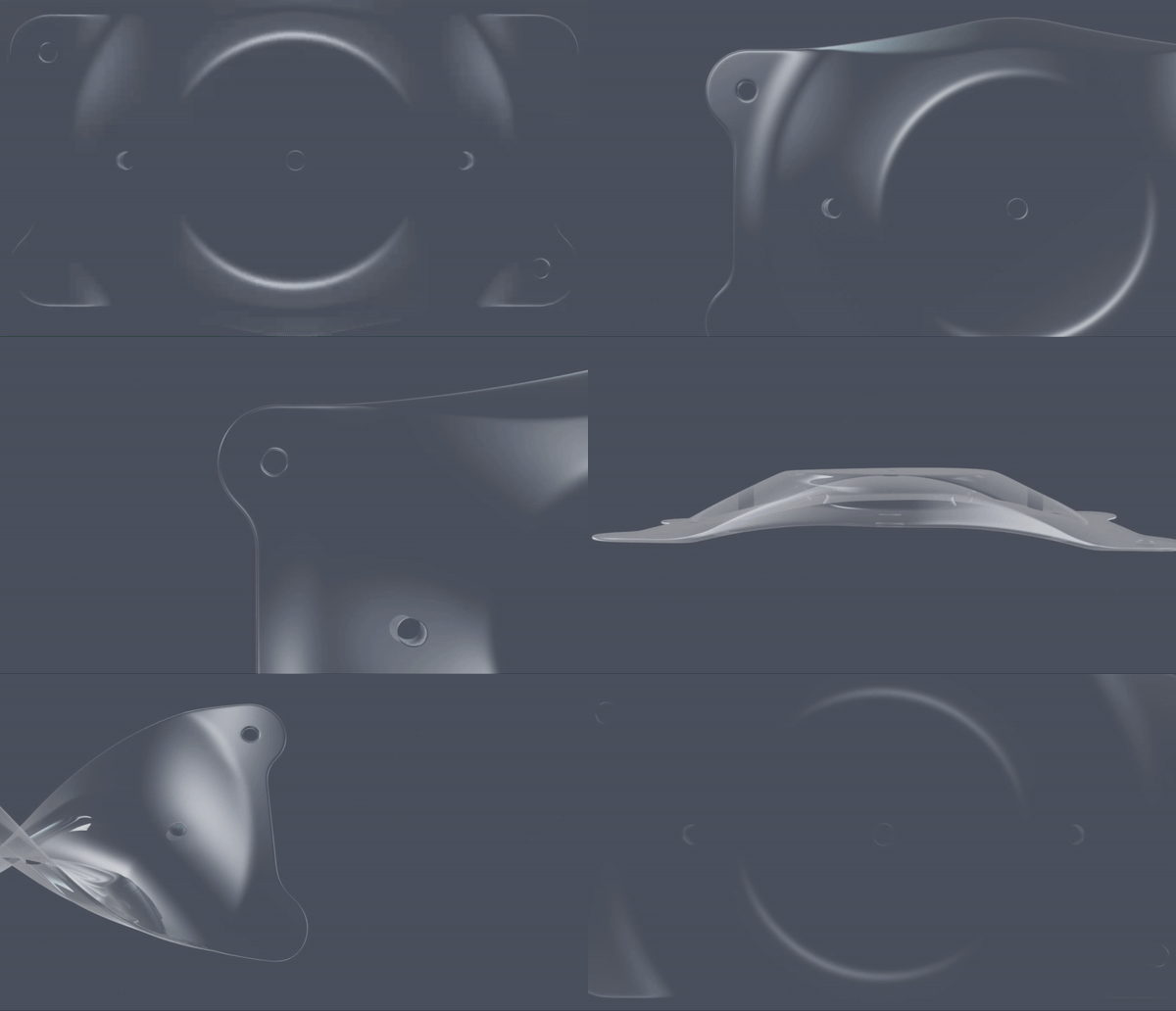
EVO ICL is a type of implantable contact lens surgery. “EVO” stands for evolution, while “ICL” stands for Implantable Collamer Lens. The procedure involves a surgeon placing a flexible, biocompatible lens between the iris and the eye’s natural lens, without removing any corneal tissue. This makes it significantly less invasive than laser eye surgery, and clinical outcomes in some patients can exceed those achieved with LASIK.
The artificial lens is made from collamer, a soft, flexible material containing purified collagen that is specially designed to work in harmony with the eye’s natural biology. EVO ICL lenses feature a tiny central hole that allows natural fluid movement within the eye, eliminating the need for pre-surgery laser iridotomy holes.
Once implanted, the lens requires no maintenance and provides a long-term solution for visual freedom. Importantly, the procedure is fully reversible if circumstances ever change.
Getting a great visual outcome starts with the talent and experience of your surgeon. That’s why we’re partnering with Dr. Robert Lin to perform EVO ICL treatment for our patients. Dr. Lin has been performing ICL surgery since 2008, and is one of the most experienced EVO ICL surgeons in the country.
Dr. Lin is the founder of IQ Laser Vision and a board-certified ophthalmologist and a corneal refractive surgeon. He received his bachelors from UC Berkeley and MD from the UCLA School of Medicine. He completed his ophthalmologist residency at the Jules Stein Eye Institute, and serves an Assistant Clinical Professor at UCLA.
The procedure to implant a permanent contact lens takes just 10-30 minutes. It is an outpatient procedure that requires minimal downtime, with many patients experiencing instant visual clarity. In many cases, patients can return to normal activities the next day.
The step-by-step process is as follows:

In order to optimize your visual results, we need to precisely fit the EVO ICL lens to the anatomy of your eye. If we choose an EVO ICL lens that is too big or too small, it may affect vision quality, stability and safety. That’s why it’s essential for optimal ICL sizing to directly measure that area inside of your eye where the EVO ICL lens will be placed.
Some ICL surgeons continue to rely solely on the use of external measurements of the eye (e.g., “white to white” measurements) to approximate the internal dimension of the eye, which can introduce errors and result in non-optimal sizing of the EVO ICL lens. That’s why we employ the advanced ArcScan ocular ultrasound system (pictured) to directly measure the internal dimensions of your eye, so we can tailor the fit of the EVO ICL lens precisely to that geometry in order to optimize your visual results.
| Feature | EVO ICL | LASIK |
|---|---|---|
| Corneal tissue removed | No | Yes |
| Reversible | Yes | No |
| Suitable for high prescriptions | Yes (up to -20.0D) | Limited |
| Suitable for thin corneas | Yes | Often not |
| Dry eye risk | Very low | Moderate |
| Procedure time | 10 to 30 minutes | Around 15 minutes |
| Recovery time | 1 to 2 days | 1 to 2 days |

During your EVO ICL surgery, you will be asked to lie on your back in a comfortable position. Numbing eye drops are applied first, ensuring the procedure is entirely painless. An eyelid holder gently keeps one eye open at a time while your surgeon works. You may see the bright light of the surgical microscope and feel slight pressure, but there is no pain involved. The process is then repeated for the second eye before you are free to rest and recover.
EVO ICL is suitable for patients aged 21 to 60 (with below 45 being preferable). It can treat the following refractive errors:
Additional candidacy requirements include:
EVO ICL is also an excellent option for patients with dry eyes or thin corneas who would not be suitable for laser correction. Your eye doctor will conduct a thorough pre-operative examination to assess your corneal thickness, eye shape, and internal dimensions before recommending the most appropriate treatment. According to the American Academy of Ophthalmology, implantable lenses are a well-established option for patients outside the typical range for laser surgery.
Not sure whether EVO ICL is right for you? Explore our full range of vision correction procedures to compare your options.
At ScottHyver Visioncare, we combine advanced diagnostic technology with some of California’s most experienced eye surgeons to deliver outstanding results.
Our EVO ICL procedures are performed by Dr. Robert T. Lin, one of California’s most experienced refractive surgeons with over 70,000 procedures completed. We also use the ArcScan ocular ultrasound system for precise internal eye measurement, a level of accuracy that many competing clinics cannot offer.
If you are looking for an ICL surgeon San Francisco residents can rely on, contact ScottHyver Visioncare to book your free no-obligation consultation today.

DALY CITY
2001 Junipero Serra Blvd
Suite 161
Daly City, CA 94014

SANTA CLARA
2901 Tasman Drive
Suite 208
Santa Clara, CA 95054

SAN RAMON
210 Porter Drive
Suite 215
San Ramon, CA 94583

Dr. Hyver founded our Santa Clara office in 2000 and spent over two decades helping patients across Silicon Valley achieve clear, lasting vision. His expertise in LASIK, SMILE, and PRK established him as one of the Bay Area’s most trusted refractive surgeons. As the official eye doctor for the 49ers, he brought exceptional precision and care to every patient he treated. Dr. Hyver retired in 2025, leaving behind a legacy of excellence that continues to guide our team. Learn more about Dr. Hyver.

Dr. Barrion is an experienced optometrist who specializes in pre-operative and post-operative care for vision correction procedures. She is dedicated to ensuring that each patient has a smooth treatment process and long-term success. Read Dr. Barrion’s full bio.

Dr. Lin is a respected ophthalmologist with extensive experience in refractive and cataract surgery. He brings advanced knowledge in innovative techniques such as Contoura LASIK and Customized PRK. Read Dr. Lin’s bio.

Dr. Phan provides comprehensive eye care with a focus on laser vision correction procedures. His experience with advanced diagnostic platforms ensures precise treatment planning for each patient. Read Dr. Phan’s bio.

Dr. Tian specializes in both general eye care and surgical support for advanced refractive treatments. He is committed to delivering safe and effective outcomes for patients in Santa Clara and beyond. Read Dr. Tian’s bio.
EVO ICL (Implantable Collamer Lens) surgery is a vision correction procedure in which a flexible, biocompatible lens is implanted between the iris and the natural lens of the eye. It corrects myopia and astigmatism without removing corneal tissue, making it a reversible and less invasive alternative to laser eye surgery.
No. The procedure is performed under anesthetic eye drops that completely numb the eye. Patients may feel mild pressure during surgery, but there is no pain. Most patients report little to no discomfort during recovery.
The implanted lens is designed to be a long-term, permanent solution. However, unlike laser surgery, it is fully reversible. The lens can be removed or replaced at any time through a short procedure if needed.
EVO ICL may not be appropriate for patients outside the 21 to 60 age range, those with unstable prescriptions, or those with certain eye conditions such as glaucoma, iritis, or diabetic eye disease. A comprehensive pre-operative assessment will determine your suitability.
During the first four hours after your EVO ICL procedure, your vision will be hazy (similar to looking through a film), and you’re likely to experience varying degrees of eye stinging, irritation, tearing, and light sensitivity.
One day after surgery, your eyes should feel relatively normal, and your vision should be clear enough (80-90% of normal) to resume most of your regular activities. However, results vary from patient-to-patient, based on the patient’s preoperative prescription and on the type of work she or he performs.
Over the next few weeks, your vision should gradually sharpen to reach its best correction.
